
Drupal Migration to Modernization
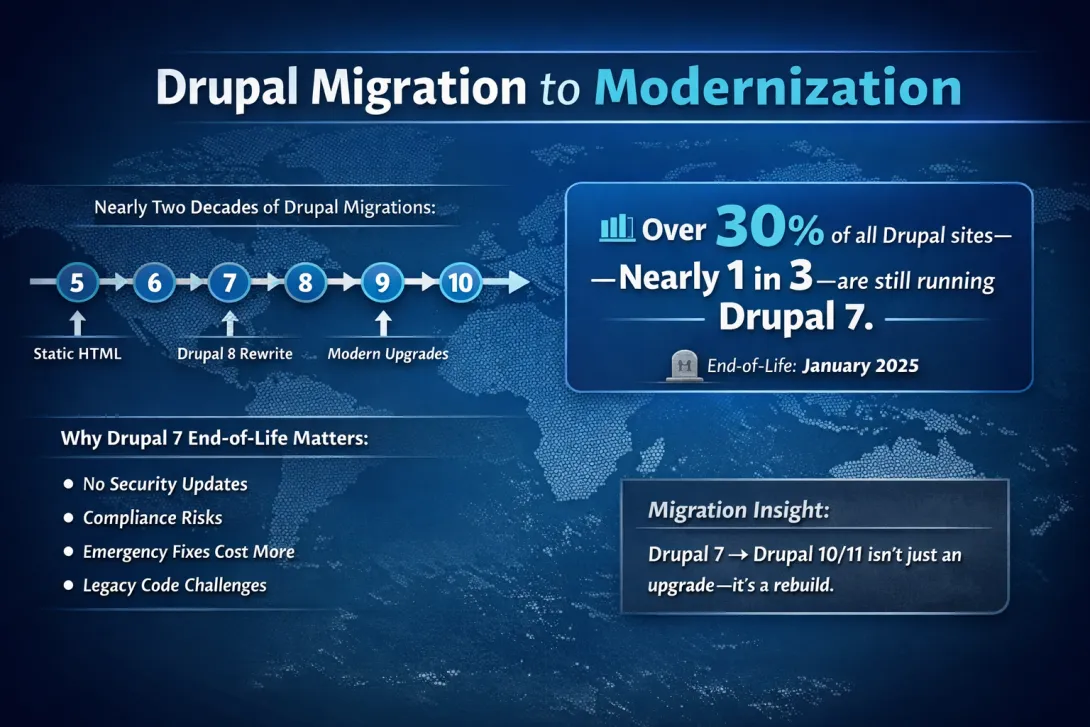
Almost 20 years ago, I downloaded Drupal for the first time. I think it was 4.6, but I can’t remember exactly where I first heard about it. Shortly after, I found myself applying for a Drupal Developer position in Sunnyvale, CA. At the time, I had already been building websites in PHP and ASP and working with other development frameworks—but Drupal was new to me.
Back then, Drupal was essentially a CMS for blogs, but it also offered something more powerful: a developer framework that allowed developers to extend it through contributed and custom modules. That flexibility hooked me early.
Over the years, I’ve worked through the major Drupal transitions from:
5 → 6
6 → 7
7 → 8
8 → 9
9 → 10
10 → 11
That’s a lot of version changes!
Early Drupal version changes—5 → 6 and 6 → 7—technically supported in-place upgrades, but in practice they were often brittle and unpredictable. In many real-world projects, it was more reliable to treat them as migrations rather than true upgrades.
The real breaking point came with Drupal 7 → 8. That transition required a full migration due to a fundamental architectural rewrite. From that point forward, Drupal finally established a sustainable path.
After Drupal 8, major version changes no longer required migrations—only upgrades.
Drupal 8 → 9 → 10 → 11 introduced a predictable, standardized upgrade process that dramatically reduced long-term maintenance pain. It’s the last version (hopefully) where upgrading forward meant rebuilding everything. That shift—more than anything else—is why so many sites are still stuck on Drupal 7.
According to Drupal.org usage statistics, there are 199,469 Drupal 7 sites still in use, compared to 33,793 sites on Drupal 11.3.x. The next largest group is Drupal 10.5.x with 102,351 sites. That means over 30%—nearly 1 in 3—of all Drupal sites are still running Drupal 7, even though it reached end-of-life in January 2025.
That’s a problem—but it’s also an opportunity.
My goal is to help Drupal 7 site owners move beyond “just upgrading.” A successful migration isn’t only about getting onto a supported version—it’s about modernizing the site so future upgrades are easier, maintenance is predictable, and the platform can actually evolve.
Done right, a migration can also:
- Improve SEO
- Strengthen accessibility
- Reduce long-term technical debt
- Set the site up for smoother upgrades going forward
Drupal migrations have been a constant thread throughout my career. At this point, they’re not just something I do—they’re something I specialize in. Drupal, when implemented thoughtfully, is a powerful platform for modernizing how organizations manage, evolve, and scale their digital presence.
If your site is still on Drupal 7, the question isn’t if you need to move—it’s how you move.
A migration done purely to “get off Drupal 7” often just recreates the same problems on a newer version. A migration done with intention modernizes the platform: cleaner content models, reduced custom code, better performance, improved accessibility, and an architecture that’s ready for Drupal 12 and beyond.
That’s the approach I take with every migration. I work with organizations to treat Drupal 7 → 11 not as a forced upgrade, but as a strategic reset—one that simplifies maintenance, lowers long-term costs, and makes future upgrades routine instead of disruptive.
If you’re ready to move beyond survival mode and turn your migration into a foundation for growth, modernization starts with the right plan—and the right partner.